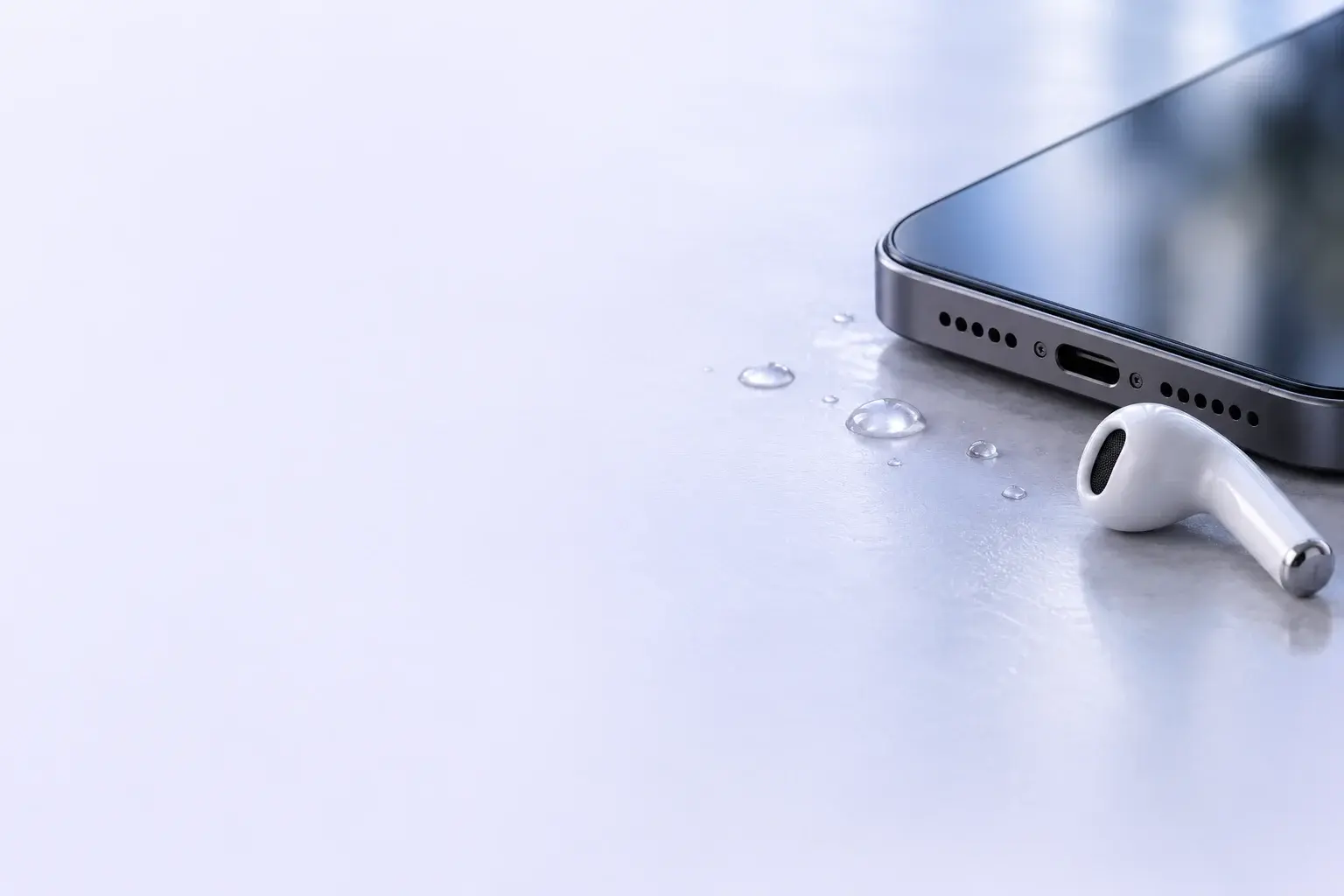
INDEPENDENT PRODUCT / MOBILE APPLICATION
Headphone Cleaner
Making sound useful meant designing how, where and when it plays.
I built a mobile audio utility with separate phone-speaker and headphone paths, guided modes, and synchronized sound and haptics on supported iPhones.
Explore Headphone Cleaner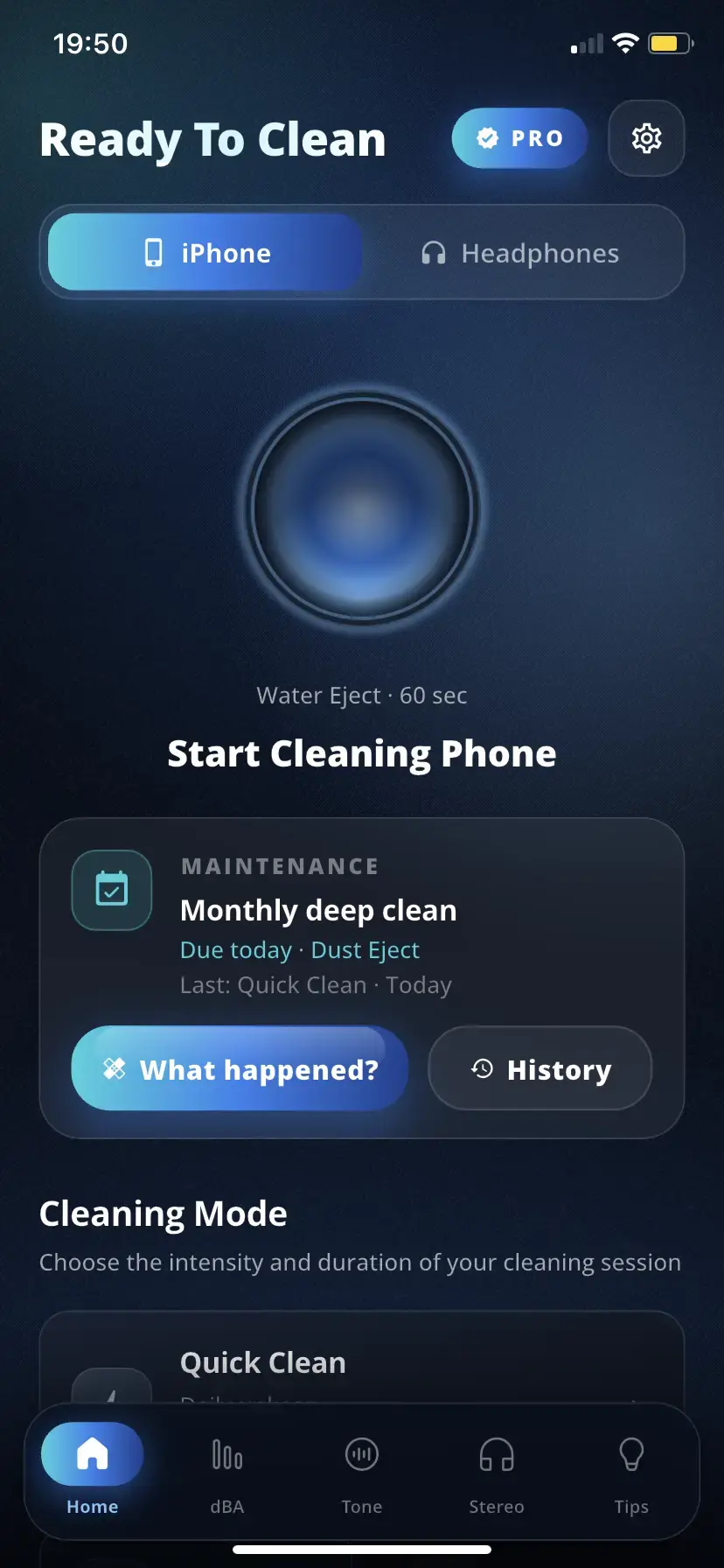
Phone speaker
Start with the need. Then choose the sequence.
When a phone speaker sounds muffled after moisture exposure, the immediate need is a clear action to take.
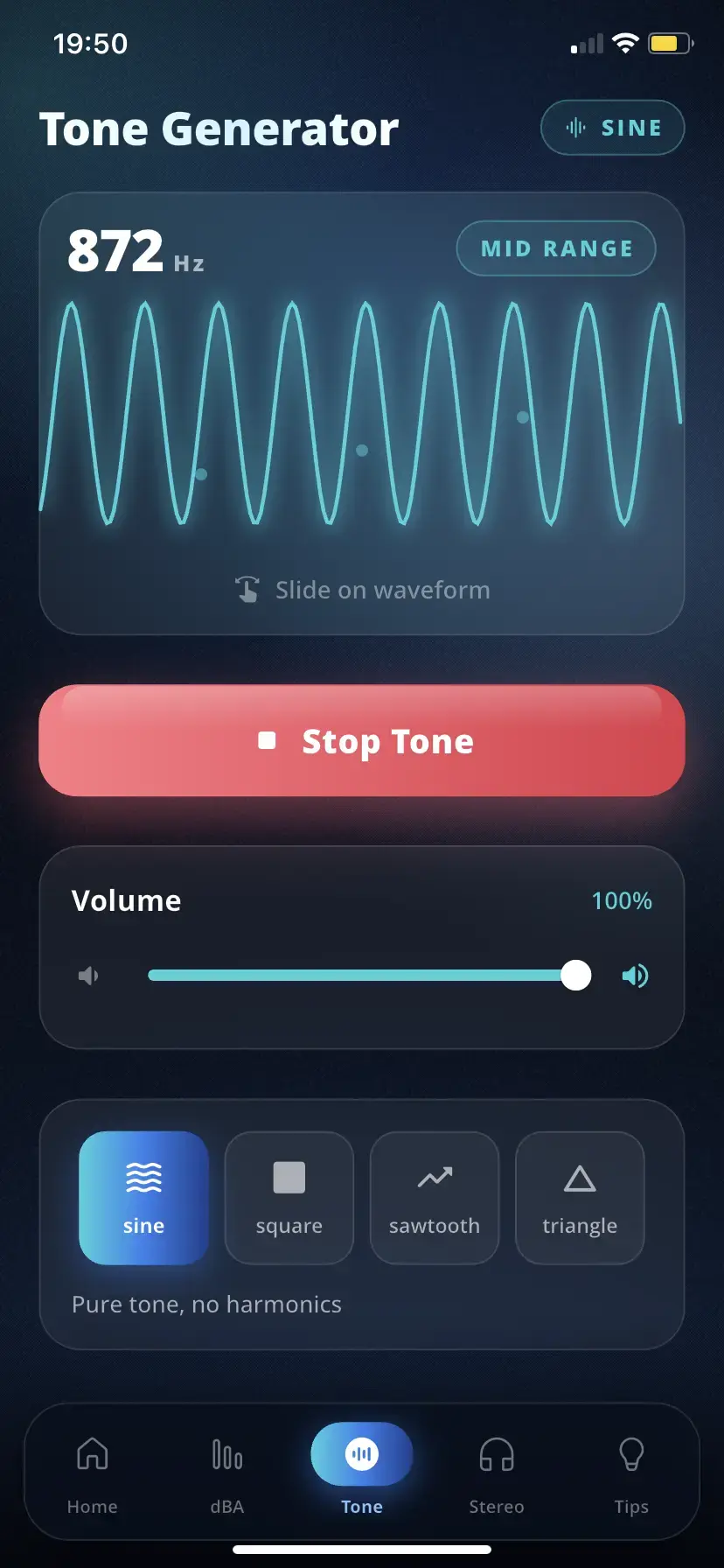
Someone could search for a tone video or use a manual frequency generator. That still leaves them choosing the output, frequency and duration. I brought those decisions into a guided flow: choose the device, then the purpose of the session.
The water sequence is designed to help move moisture near the speaker opening. Headphone playback is a separate case, with audio routed to the connected headphones and no phone haptics.
Phone speaker
Sound + synchronized haptics
Water, Dust and Quick on supported iPhones. Channel segments play through both channels.Headphones
The program, with separate channels
Audio only. Water plays its pulsed sequence on the left, then the right.I kept two decisions separate: the program chooses the sound pattern; the device choice determines its output and channel handling. For Water Eject, switching from headphones to the phone keeps the sequence but plays each channel segment through both channels, with synchronized haptics on supported iPhones. Mesh and Bass Port remain audio-only listening programs in either mode.
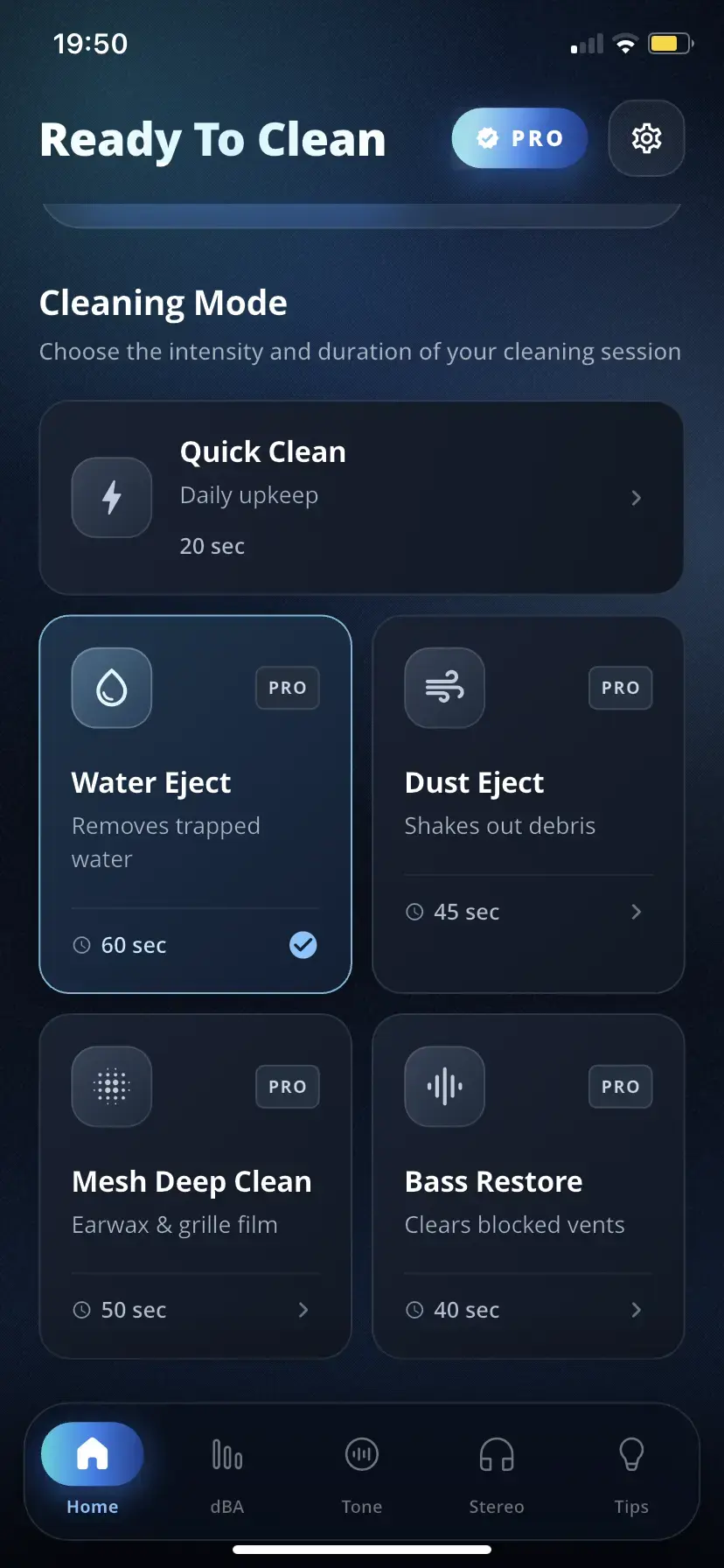
Different jobs deserve different patterns.
I separated Water Eject, Dust Eject and Quick Clean into distinct programs, with different sweeps, pulses and durations. The person chooses a purpose; the program holds the signal details.
Mesh and bass modes provide listening sequences. I kept that role distinct from the water-ejection goal.
Lower-band sweeps and pulsed holds
Dust EjectA different sweep and pulse schedule
Quick CleanA shorter sequence
Research changed the design choices.
Frequency, timing and mechanical coupling all matter. A single number cannot describe the whole interaction.
I drew on work about droplet resonance, acoustic water removal and vibration-driven particle release when shaping the sequences. Apple's Core Haptics documentation provided the implementation foundation for playing audio and haptics together.
The studies informed the design. The app's frequency ranges, durations and intensities remain my engineering choices; the papers do not establish device-specific cleaning effectiveness.
- Shin & Lim2014European Physical Journal EShape oscillation and detachment conditions for a droplet on a vibrating flat surface
Droplet response depends on the vibration, its amplitude and the surface. This informed exploring frequency ranges instead of treating one tone as universal.
The study concerns a mechanically vibrating flat surface. - Mortazavi et al.2019Journal of The Electrochemical SocietyEnhanced Water Removal from PEM Fuel Cells Using Acoustic Pressure Waves
Acoustic pressure and pulsed excitation informed the investigation of active and resting periods in the sound sequences.
The apparatus is a fuel-cell channel with airflow; its numerical results are not phone presets. - ApplePlatform documentationCore HapticsScheduling audio and haptics on one engine clock
The direct engineering foundation: register the generated audio with Core Haptics, then schedule audio and haptic players against the same engine time.
Official platform documentation, alongside the scientific literature. - Huang et al.2023IEEE Transactions on Mobile ComputingA Portable and Convenient System for Unknown Liquid Identification With Smartphone Vibration
Vi-Liquid explores transferring a phone motor's vibration into liquid through a container. It informed the investigation of sustained vibration and resting windows.
Its purpose is liquid identification, rather than speaker water removal. - Abubakar et al.2020Scientific ReportsEnvironmental dust repelling from hydrophobic and hydrophilic surfaces under vibrational excitation
Surface properties, adhesion and inclination affect particle release. This challenged the assumption that simply raising the tone would be enough for dust.
The work uses vibrating glass surfaces.
A focused utility, carried from product choices to native playback.
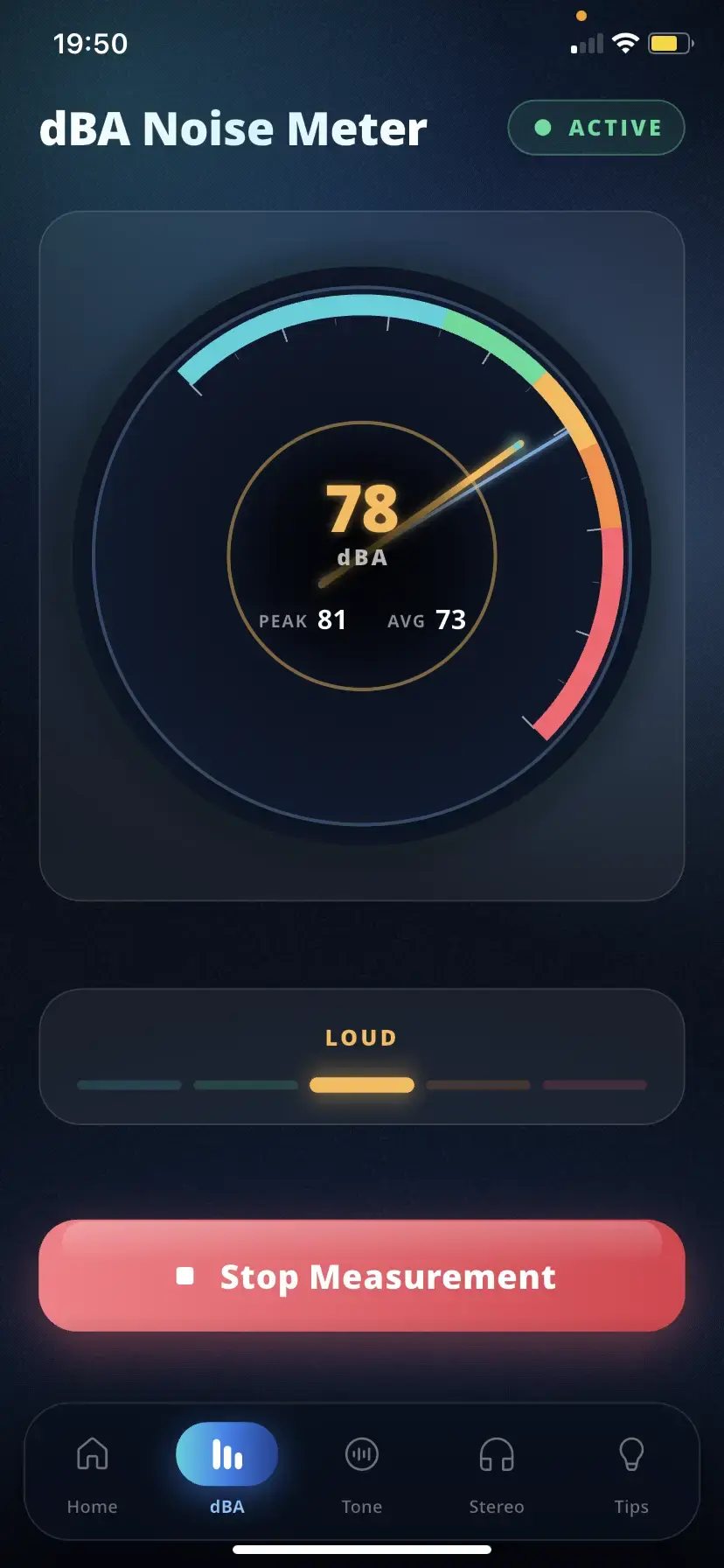
I designed and built the mode selection, generated audio programs, headphone routing and synchronized phone playback as one product. It is released on the App Store and has passed 2,000 downloads.